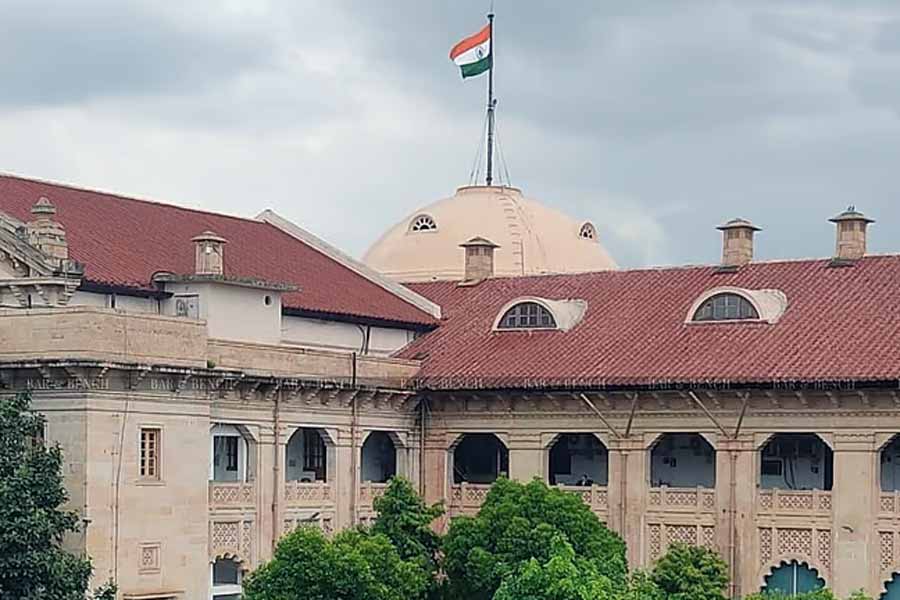
Allahabad High Court.
Prayagraj, March 20, 2026 — In a significant ruling expanding the scope of compensation in accident cases, the Allahabad High Court has directed the Indian Railways to pay an additional ₹8 lakh for the loss of an unborn child who died along with a pregnant woman in a train accident.
The judgment came in the case of Shri Sukhnandan v Union of India, where the Court held that a foetus aged five months or more can be treated as a child in existence for the purpose of awarding compensation.
Case background
The incident dates back to 2018, when a pregnant woman died while attempting to board the Marudhar Express. She was travelling from Barabanki to Bandikul Railway Station at the time of the accident.
In 2025, the Railway Claims Tribunal had awarded ₹8 lakh compensation for the woman’s death. However, her family later approached the High Court seeking additional compensation for the loss of the unborn child, which was estimated to be around 8–9 months old.
Foetus recognised as a ‘person’ in law

Justice Prashant Kumar, Allahabad High Court.
Delivering the judgment on February 26, Justice Prashant Kumar relied on the Supreme Court’s ruling in Kamna Sharma v. Union of India to affirm that a sufficiently developed foetus has legal recognition.
“Human foetus to whom personhood could be attributed was also destroyed in the accident… had the accident not occurred the unborn child would have survived,” the Court observed.
The Bench emphasised that the loss of a foetus is effectively the loss of a child, and that the unborn child must be treated as a separate legal entity for the purpose of damages.
READ: CJI Surya Kant Recuses from Hearing Pleas Challenging Election Commissioner Appointment Law
Independent compensation for unborn child
The Court ruled that the death of the foetus constitutes an independent accident, separate from the death of the mother.
“The unborn child… is held to be a ‘person’ who can be the subject of an action for damages for his death,” the Court stated, adding that the family is entitled to separate compensation.
Accordingly, it directed the Railways to pay an additional ₹8 lakh to the claimants for the loss of the foetus.
Railways’ statutory liability upheld
Although the term “foetus” is not explicitly mentioned in the Railways Act 1989, the Court held that the case falls within the ambit of Section 124A, which deals with compensation for deaths arising from “untoward incidents” in railway operations.
The ruling reaffirmed that the Railways bears statutory liability in such cases, regardless of specific terminology.
Consistent judicial approach
The High Court also referred to similar rulings by other High Courts, including those of Karnataka, Madhya Pradesh, and Andhra Pradesh, which have recognised the death of a foetus as equivalent to the death of a child for compensation purposes.
These precedents, the Court noted, reinforce the principle that legal protections extend to unborn children, particularly in cases where the foetus has reached an advanced stage of development.
READ: Allahabad High Court Upholds 10-Month NSA Detention Over Navratri Cattle Slaughter
Legal representation
The petitioner was represented by advocates Pradeep Kumar Singh, Amit Kumar, and Amrita Singh, while the Indian Railways was represented by advocate Mahendra Kumar.
Broader implications
The ruling is expected to have far-reaching implications for accident compensation law in India, particularly in recognising the rights of unborn children and expanding the interpretation of “personhood” in civil liability cases.
By affirming that a foetus beyond five months can be treated as a legal person, the judgment strengthens the framework for awarding damages in cases involving prenatal loss and aligns with a growing body of judicial precedent across Indian courts.