Court warns against coercive or induced conversions; says cultural coercion endangers tribal identity and social harmony.
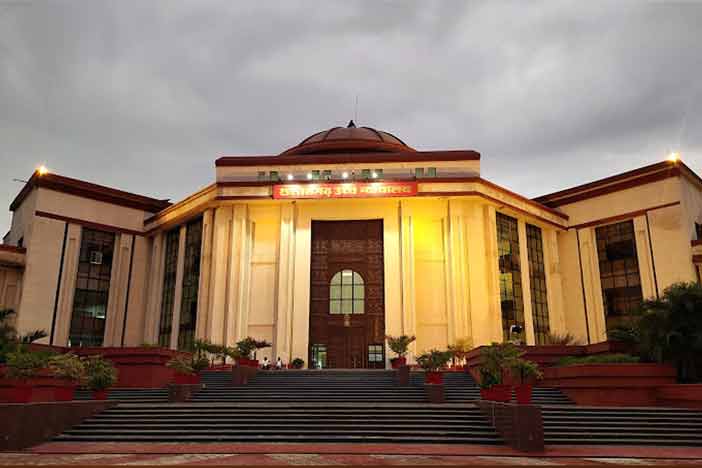
Chhattisgarh High Court.
Induced Religious Conversions of Tribals by Missionaries Threaten India’s Unity: Raipur, November 3, 2025: The Chhattisgarh High Court has expressed serious concern over the phenomenon of induced religious conversions among tribal communities, observing that large-scale conversions to Christianity—particularly those driven by inducement or coercion—pose a threat to India’s unity and cultural continuity.
A Division Bench of Chief Justice Ramesh Sinha and Justice Bibhu Datta Guru, while hearing a batch of petitions related to the alleged prohibition of entry of Christians into several villages, said that “mass or motivated conversions not only disturb social harmony but also challenge the cultural identity of indigenous communities.”
The Court was dealing with petitions filed after reports emerged that at least eight villages in Kanker District had put up hoardings prohibiting the entry of pastors and “converted Christians.” The petitioners argued that such restrictions violated their constitutional rights.
READ: DHCBA Raises Concerns Over Delhi High Court’s Move to Introduce Working Saturdays
Court flags misuse of right to propagate religion
Acknowledging that the Constitution guarantees every citizen the right to propagate their religion, the Bench cautioned that the right cannot be misused for “coercion, inducement, or deception.”
“Among economically and socially deprived sections, especially Scheduled Tribes and Scheduled Castes, there has been gradual religious conversion under the promise of better livelihoods, education, or equality,” the Court observed.
“What was once seen as service has, in many cases, become a subtle instrument of religious expansion.”
The judges noted that in several remote tribal regions, missionaries were accused of targeting illiterate and impoverished families by offering monetary assistance, free education, healthcare, or employment in exchange for conversion. Such practices, the Court said, “distort the spirit of voluntary faith and amount to cultural coercion.”
READ: Explained: Why the Supreme Court Ruled That Not Every Lawyer Is an Advocate
Impact on tribal culture and community life
The Bench highlighted that religious conversion often disrupts the organic fabric of tribal life, leading to the loss of indigenous traditions, rituals, and languages.
“Conversion disrupts this organic connection. The erosion of tribal faiths results in the loss of indigenous languages, rituals, and customary laws,” the judgment said.
“Newly converted individuals sometimes face rejection from their original communities, causing isolation and fragmentation.”
The Court further pointed out that such conversions can also influence political representation, since Scheduled Tribe or Scheduled Caste benefits are often tied to religious identity — thereby altering demographic patterns and political dynamics.
‘Faith must be conviction, not compulsion’
While reaffirming India’s secular values, the Court underscored that religious conversion is legitimate only when it is voluntary and spiritual, not when achieved through manipulation.
“When it becomes a calculated act of exploitation disguised as charity, it undermines both faith and freedom,” the Court said.
“Conversion by inducement is not merely a religious concern — it is a social menace that threatens the unity and cultural continuity of India’s indigenous communities.”
READ: Alimony can’t be awarded to financially independent spouse: Delhi High Court
On village hoardings and restrictions
Addressing the specific issue of the hoardings erected in Kanker villages, the Court observed that these appeared to have been installed by Gram Sabhas under powers granted by the Panchayat (Extension to Scheduled Areas) Act, 1996 (PESA), following a circular issued by the State government.
However, it found that the circular did not authorise discrimination against any community. The Bench clarified that the hoardings restricted only conversion activities, not the general entry of Christians.
“The apprehension that Christians in general have been banned from villages is unfounded,” the judges stated. “The hoardings seem to be precautionary measures intended to protect the interests of indigenous tribes and local cultural heritage.”
Citing Article 25 of the Constitution, the Court emphasised that the “right to propagate religion” does not extend to conversions achieved through force, inducement, or fraud, as prohibited under the Chhattisgarh Freedom of Religion Act, 1968.
READ: Supreme Court Declares Housing a Fundamental Right, Tightens Rules for New Projects
No relief, but alternative remedy available
The Court declined to grant relief to the petitioners, observing that they could first approach the concerned Gram Sabha and, if aggrieved, file an appeal before the Sub-Divisional Officer (Revenue).
It also clarified that if the petitioners feared being prevented from entering their villages or faced any threats, they could seek protection from the police.
Legal Representation in Court
The petitioners were represented by Advocates Kishore Narayan, Arpit Lall, and Ayush Lall.
The State of Chhattisgarh was represented by Additional Advocate General Y.S. Thakur, while a team of lawyers including Sangharsh Pandey, Anupam Dubey, B. Gopa Kumar, Himanshu Pandey, Palash Tiwari, Rohit Sharma, Harshal Chouhan, Mahesh Kumar Mishra, Vaibhav P. Shukla, Vivek Kumar Agrawal, and Jay Singh appeared for other respondents.
In essence, the Chhattisgarh High Court’s ruling underscores a delicate balance between protecting the right to religious freedom and safeguarding the cultural identity and social fabric of India’s tribal communities — urging that faith remain “a matter of conviction, not compulsion.”
READ: Law Minister Calls for Reconsideration of Section 34 of Arbitration Act to Address Pendency of Cases