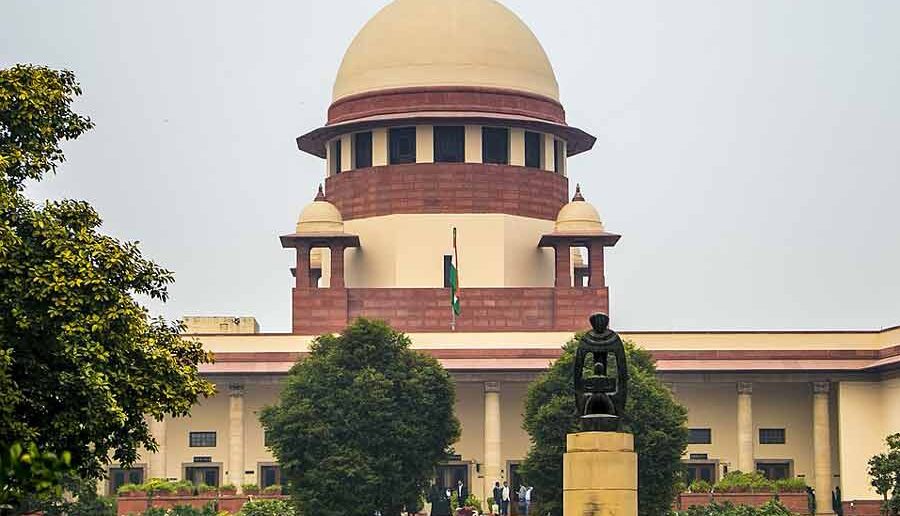
Supreme Court of India.
Supreme Court Explains Case Law on Enforcement of Arbitration Clause by non-signatory to a Contract: New Delhi — In a significant ruling tightening the law on arbitration, the Supreme Court has held that a sub-contractor who is not a signatory to a contract cannot force arbitration against the principal employer unless it can establish a clear and “veritable” legal relationship with the parties to the arbitration agreement.
A Bench of Justice J.B. Pardiwala and Justice K.V. Viswanathan delivered the judgment in Hindustan Petroleum Corporation Ltd. vs. BCL Secure Premises Pvt. Ltd. (Civil Appeal No. 14647 of 2025), setting aside a Bombay High Court order that had permitted a sub-contractor to invoke arbitration under Section 11 of the Arbitration and Conciliation Act, 1996.
Allowing HPCL’s appeal, the Supreme Court held that BCL Secure Premises Pvt. Ltd., a sub-vendor, failed even at the prima facie stage to show that it was a genuine party to the arbitration agreement contained in HPCL’s main contract.
“The referral court is not a monotonous automation where absolute strangers can walk in and compel arbitration,” the Court observed, underscoring that judicial scrutiny at the referral stage is both necessary and mandated by law.
READ: Resignation Forfeits Pension, But Gratuity Is a Statutory Right: Supreme Court
Dispute arose from HPCL tender
The case stemmed from a tender floated by HPCL for the supply and installation of Tank Truck Locking Systems (TTLS), which was awarded to AGC Networks Ltd. BCL entered into a back-to-back arrangement with AGC as a sub-contractor and later claimed that it had executed substantial portions of the work.
BCL relied on an Assignment-cum-Settlement Agreement dated October 31, 2023, under which AGC (now Black Box Ltd.) purportedly assigned its receivables from HPCL to BCL. On this basis, BCL invoked arbitration and claimed more than ₹3 crore from HPCL.
The Bombay High Court, in April 2025, appointed an arbitrator while leaving the issue of jurisdiction to be decided by the arbitral tribunal under Section 16 of the Act.
READ: Supreme Court mandates disclosure of cross-cases in chargesheets to avoid trial delays
Supreme Court rejects “hands-off” approach
The Supreme Court disagreed with the High Court’s approach, holding that courts exercising jurisdiction under Section 11 cannot abdicate their duty when a non-signatory seeks to invoke arbitration.
“This does not mean that where the Referral Court finds prima facie a party is not a veritable party, still the matter is left to the Arbitral Tribunal,” the Bench said, adding that such deference would reduce the referral court to a mere rubber stamp.
The Court found that there was no privity of contract between HPCL and BCL, no express consent from HPCL to involve BCL, and an express prohibition in the tender documents against subletting or assignment without prior written approval.
READ: Supreme Court’s New Rules for Mentioning, Adjournment, and Urgent Listings Come into Force
‘Veritable party’ test reaffirmed
Relying heavily on the Constitution Bench judgment in Cox & Kings Ltd. v. SAP India (2024), the Court reiterated that a non-signatory must satisfy the stringent “veritable party” test to enforce an arbitration clause.
Justice Viswanathan, writing for the Bench, noted that “mere commercial connection” or operational involvement does not elevate a third party to the status of a party to the arbitration agreement.
“The respondent fails the prima facie test of being a veritable party to the arbitration agreement between HPCL and AGC,” the Court held, observing that the parties “operated on separate orbits.”
The judgment also clarified that assignment of contractual obligations or receivables requires consent, and in the absence of HPCL’s written approval, no arbitration obligation could be imposed on it.
READ: JSA Advises Baashyaam Group on $144 Million Acquisition of Haddows Road Property in Chennai
Section 11 courts must scrutinise claims
The Supreme Court emphasised that Section 11(6-A) empowers referral courts to conduct a limited but meaningful scrutiny of whether a valid arbitration agreement exists.
“The use of the term ‘examination’ under Section 11(6-A) implies that the scope of enquiry is limited to a prima facie scrutiny of the existence of the arbitration agreement,” the Bench said, adding that vexatious or speculative arbitration claims must be filtered out at the threshold.
READ: Alimony can’t be awarded to financially independent spouse: Delhi High Court
Arbitration plea dismissed
Concluding that no arbitration agreement existed between HPCL and BCL, the Supreme Court dismissed the arbitration application and allowed HPCL’s appeal.
“If the respondent has any other remedy available in law, it is at liberty to pursue the same,” the Court clarified, while directing that any such proceedings be decided independently on their merits.
The ruling sends a clear message that while arbitration is encouraged as an alternative dispute resolution mechanism, it cannot be invoked by non-signatories without contractual legitimacy or demonstrable consent.