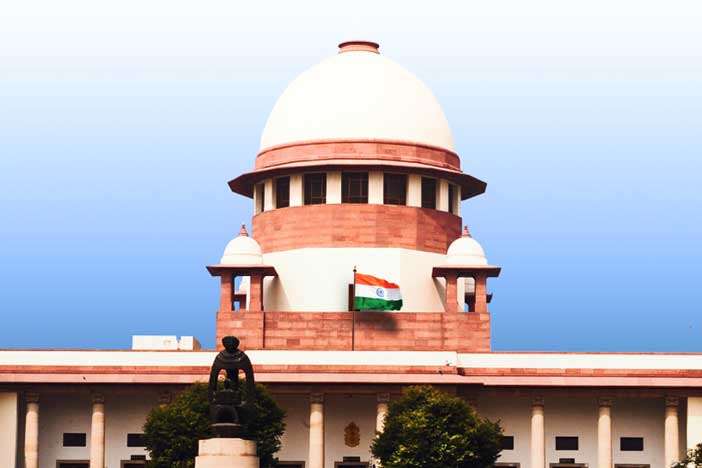
Supreme Court of India.
Supreme Court settles case law on High Court’s powers under Article 227: New Delhi: The Supreme Court has emphatically reiterated the limited scope of High Courts’ supervisory jurisdiction under Article 227 of the Constitution, holding that such powers cannot be used to re-evaluate evidence or substitute findings of subordinate courts.
In a significant ruling, a bench comprising Justice Aravind Kumar and Justice N.V. Anjaria laid down clear principles governing the exercise of Article 227 jurisdiction, stressing that High Courts must refrain from acting as appellate authorities while exercising supervisory control.
The Supreme Court underscored that interference under Article 227 is warranted only in exceptional circumstances—such as when a subordinate court assumes jurisdiction it does not possess, grossly abuses its authority, or unjustifiably refuses to exercise jurisdiction vested in it. Outside these narrow grounds, the High Court’s role remains strictly supervisory.
“The High Court cannot act as an appellate court to adjudicate the plea on merits,” the bench observed, adding that its scrutiny must be confined to examining jurisdictional errors or perversity in findings so grave that no reasonable person could have arrived at such conclusions.
Principles Laid Down
The judgment crystallizes key principles governing Article 227:
- The power of superintendence is to be exercised sparingly and only in cases of jurisdictional error, abuse, or refusal to exercise jurisdiction.
- High Courts cannot substitute their own judgment for that of subordinate courts where no apparent error exists on the face of the record.
- Supervisory jurisdiction does not permit reappreciation or reweighing of evidence.
- Not every factual or legal error warrants interference if the ultimate conclusion is sustainable.
The Court cautioned that expanding the scope of Article 227 would blur the distinction between supervisory and appellate jurisdiction, undermining the judicial hierarchy.
READ: Arbitration Risks Becoming Just Like Court Proceedings, Says Supreme Court Justice Manmohan
Background of the Dispute
The case stemmed from a 2007 compromise between Nandi Infrastructure Corridor Enterprises Ltd. (NICE) and landowners in Bengaluru. Under the agreement, NICE acquired portions of land for a road infrastructure project, promising either alternate land or compensation based on prevailing government guideline values.
When NICE failed to provide alternate land, the landowners approached the executing court, which fixed compensation at ₹1,000 per square foot. However, the High Court, invoking its powers under Article 227, reduced the compensation to ₹500 per square foot.
This prompted NICE to challenge the High Court’s intervention before the Supreme Court.
Supreme Court’s Verdict
Allowing the appeal, the Supreme Court set aside the High Court’s decision and restored the executing court’s award. The judgment, authored by Justice Aravind Kumar, held that the High Court had overstepped its jurisdiction by reassessing the compensation amount.
The bench observed that the High Court effectively acted as an appellate court by adopting an alternative view, despite the absence of any jurisdictional error in the executing court’s decision.
“By re-determining the compensation amount, the High Court transgressed its jurisdiction,” the Court held, adding that such interference falls outside the “narrow and circumscribed scrutiny” permissible under Article 227.
The ruling reinforces that disagreement with a lower court’s reasoning does not justify supervisory intervention, so long as the decision is reasonable and legally sustainable.
Legal Representation
For the appellants, the case was argued by advocate P. Vishwanatha Shetty, advocate Sharan Dev Singh Thakur, advocate Mahesh Thakur, advocate Vibhav Chaturvedi, advocate Narveer Yadav, advocate Akshay Kumar, advocate Siddhartha Sati, advocate Anil Kaushik, advocate Supreeta Sharanagouda, advocate Sharanagouda Patil, advocate S.B. Mathapati, and advocate Kotrabasappa.
The respondents were represented by advocate Anil Kaushik, advocate Supreeta Sharanagouda, advocate Sharanagouda Patil, advocate S.B. Mathapati, advocate Kotrabasappa, advocate P. Vishwanatha Shetty, advocate Sharan Dev Singh Thakur, advocate Mahesh Thakur, advocate Vibhav Chaturvedi, advocate Narveer Yadav, advocate Akshay Kumar, and advocate Siddhartha Sati.
Court Case Details
Case Title: Nandi Infrastructure Corridor Enterprises Ltd. & Anr. versus B. Gurappa Naidu & Ors.
Citation: 2026 LiveLaw (SC) 445
The judgment is expected to serve as a key precedent in defining the contours of Article 227 jurisdiction and curbing its misuse as a de facto appellate mechanism.
READ: Allahabad High Court Awards Rs 8 Lakh Compensation for Death of Unborn Child in Train Accident