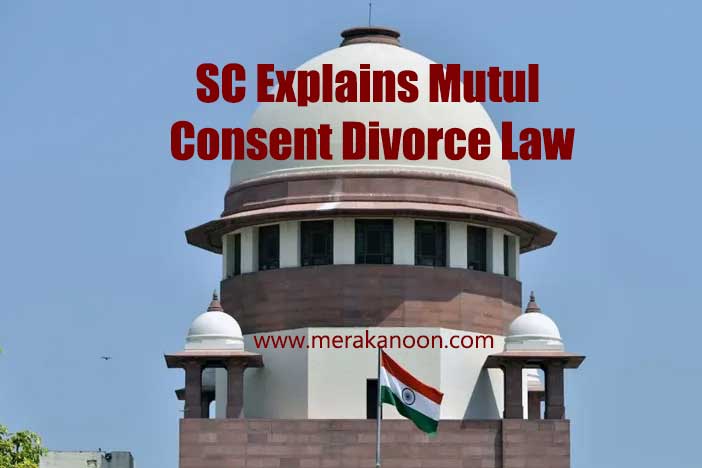
Supreme Court of India.
Supreme Court Case Law on Mutual Consent Divorce in India: New Delhi: In a strongly worded judgment, the Supreme Court of India has dissolved a 23-year-old marriage, invoking its extraordinary powers under Article 142 of the Constitution, after finding that the relationship between the couple had irretrievably broken down. The court came down heavily on the wife for retracting her consent from a mutually agreed divorce and for making what it called “highly egregious” and “audacious” claims involving massive sums of undisclosed jewellery and gold.
The bench comprising Justice Rajesh Bindal and Justice Vijay Bishnoi delivered the verdict on April 13, making scathing observations about the wife’s conduct and the sanctity of settlement agreements reached through mediation.
The Dispute: From Mutual Consent to Contentious Breakdown
The couple, married in 2000, had been living separately for the past few years following prolonged marital discord. In 2023, the husband approached the court seeking a divorce. Following mediation, both parties reportedly reached a comprehensive settlement resolving their financial and personal disputes.
Under the mutually agreed settlement, the husband agreed to withdraw his divorce petition, pay the wife ₹1.5 crore in two instalments, purchase a car worth ₹14 lakh, and hand over certain jewellery items. The wife, in turn, promised to execute a gift deed transferring ₹2.5 crore from their jointly owned business account to her husband.
However, just before the second motion for mutual consent could be filed—an essential procedural step under Section 13B of the Hindu Marriage Act—the wife withdrew her consent, claiming that the husband had failed to fulfill additional promises allegedly made outside the written agreement.
The “Extravagant” Claims and the Court’s Rebuke
The wife alleged that her husband had promised her additional jewellery worth ₹120 crore and gold biscuits worth ₹50 crore as part of an unofficial arrangement to compensate her “stri dhan,” but these terms were supposedly excluded from the formal settlement to avoid attracting wealth tax scrutiny.
The Supreme Court rejected these claims outright, describing them as “extravagant and egregious.” The bench observed:
“Another argument raised by the wife, that she only agreed to exclude these terms from the settlement agreement upon being asked so by the husband in order to avoid alerting the Income Tax department, and to evade any liability towards wealth tax, is highly egregious. We are appalled at the sheer audacity of such a submission being advanced before a court of law, and deplore the evident disregard exhibited towards the legal system.”
Calling her story “unbelievable,” the court noted that the wife failed to explain why such an enormous claim was not reflected in the signed and authenticated settlement deed.
Settlement Withdrawal and Cost of Breach
Clarifying the law on mutual consent divorce, the court reaffirmed that while it is legally permissible for a spouse to withdraw consent before the court grants divorce, such withdrawal cannot be allowed when a binding settlement agreement resolving all disputes has been executed.
The bench remarked: “Though it is well within the law for any party to withdraw consent at any stage before grant of divorce by mutual agreement, however, in case a compromise deed or a settlement agreement has been entered between the parties, regarding the full and final settlement of their disputes, it is not open for the party to step back from the terms and conditions so arrived between them.”
The justices emphasized that resiling from a mediated and court-endorsed settlement undermines the very foundation of the mediation process and must be met with deterrent consequences, including high costs.
Domestic Violence Proceedings “Premeditated”
Adding to its criticism, the Supreme Court also quashed a complaint the wife had filed under the Domestic Violence (DV) Act, terming it “premeditated” and “vexatious.”
The court found no specific allegations of violence in the wife’s petition and observed that it was filed nearly eight months after she backed out of the mutual divorce settlement—suggesting it was intended to prolong litigation rather than seek genuine redress.
“A criminal complaint regarding domestic violence, with mere reference to the names of family members or the husband, without any specific allegation that points towards their active involvement in the commission of such an act of violence, shall be nipped in the bud,” the bench stated.
It further cautioned against allowing emotional disputes to spiral into criminal proceedings, warning that doing so would amount to an abuse of legal process and cause harassment to the other party.
READ: Delhi High Court Upholds Earlier Buyer’s Rights, Voids Subsequent Property Sale
Irretrievable Breakdown and Article 142
In concluding its judgment, the Supreme Court held that there was no scope for reconciliation between the parties, who had been living apart for several years, and that continued litigation would serve no purpose.
“We conclude that the present is a fit case for exercise of powers under Article 142(1) to grant a divorce as there had been an irretrievable breakdown of the marriage,” said the bench.
By exercising Article 142, the apex court sought to do complete justice between the parties, bringing finality to a prolonged and embittered dispute.
The ruling underscores the Supreme Court’s unwavering stance on upholding the sanctity of mediated settlements, particularly in matrimonial cases. It sends a clear message that withdrawing from a court-endorsed or mediated settlement without valid grounds can attract judicial reproach and legal consequences.
The decision also highlights the court’s growing readiness to use Article 142 powers to terminate marriages that have clearly collapsed—emphasizing substance and finality over mere procedural formality.
By quashing both the DV proceedings and the wife’s extravagant claims, the bench brought closure to a legal battle that had stretched for years, marking another step in the court’s effort to streamline matrimonial adjudication and curb misuse of the justice system.
READ: Lawyers Push Back: Allahabad HC Bar Fights Plan to Make Courts Work Two Saturdays a Month