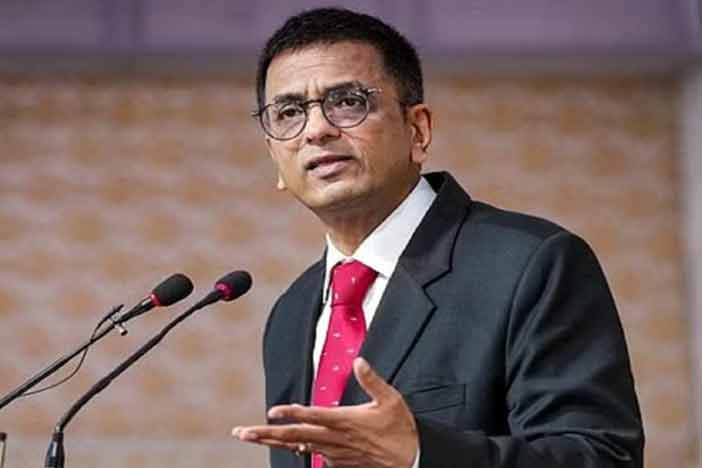
DY Chandrachud, Former CJI.
AI-Based Resolution of Cheque Bounce Cases Feasible, Says Ex-CJI Justice Chandrachud: New Delhi, India – Former Chief Justice of India, Justice DY Chandrachud, has suggested that artificial intelligence (AI) could be used to resolve certain categories of litigation, particularly cheque dishonour cases, as part of efforts to address India’s growing judicial pendency. Speaking at the IBA Litigation and ADR Symposium on Saturday, Justice Chandrachud highlighted the potential of AI in accelerating the adjudication of transactional disputes without compromising fairness.
Justice Chandrachud’s remarks came during the keynote address at the symposium session themed, “The Benefits and Impact of Artificial Intelligence on Dispute Resolution,” where he explored the intersection of technology, constitutionalism, and the future of dispute resolution. The session was chaired by Carlo Portatadino of Tombari D’Angelo e Associati, Milan, and included panellists such as Senior Advocate Jayant Mehta, Mahesh Rai from Drew & Napier (Singapore), and Professor Tania Sourdin, Professor Emerita at the University of Newcastle, Australia.
READ: Mediation Must Move Beyond Elite Legal Spaces: Former CJI BR Gavai
AI and Cheque Dishonour Disputes: A Solution for Pendency
Justice Chandrachud noted that one of the largest categories of pending cases in India involves cheque bounce disputes, a matter that has contributed significantly to the backlog in magistrate courts. He proposed that an AI-driven adjudication model could help resolve such cases, given their transactional nature and volume. “Cheque bounce cases could potentially be automated, as the outcomes of these cases generally do not have significant consequences on basic human rights,” he said.
He further added that AI could assist in resolving such disputes efficiently, freeing up judicial officers to focus on more complex cases requiring deeper deliberation. Justice Chandrachud referenced the success of Delhi’s virtual courts, which have been used to address routine traffic offences and small-ticket claims. He suggested that a similar model could be considered for cheque dishonour cases, where standardized resolutions could be implemented through AI systems.
READ: JSA Advises Baashyaam Group on $144 Million Acquisition of Haddows Road Property in Chennai
AI’s Role in Other Legal Domains: Opportunities and Cautions
While expressing enthusiasm about AI’s potential to streamline specific legal areas, Justice Chandrachud also urged caution. He emphasized that certain sensitive matters, such as housing and rent control litigation, must remain under human oversight due to the potential impact on vulnerable tenants. Similarly, motor accident compensation claims could incorporate AI to offer optional, instant awards from insurers, allowing victims the choice of accepting a quick settlement or pursuing judicial adjudication.
“The efficiency of AI can be harnessed in cases where the impact is not profound, but in areas with far-reaching consequences for individuals’ lives, human oversight is indispensable,” he cautioned.
READ: Supreme Court’s New Rules for Mentioning, Adjournment, and Urgent Listings Come into Force
Balancing Efficiency and Fairness in the Judiciary
Justice Chandrachud also highlighted the growing importance of efficiency in the judicial process, calling it a “constitutional value” that must be balanced with access and fairness. He pointed out that India’s focus on procedural guarantees and access to justice, while noble, has sometimes led to an overburdened court system. “We have virtually rendered our court system dysfunctional in an eagerness to ensure the fullest access to justice and procedural rights,” he stated, underscoring the need for a balance between access to justice and timely outcomes.
He warned that the quest for perfection in judicial processes could, paradoxically, lead to delays and inefficiencies, ultimately failing those who need justice the most. “At some stage, we have to allow for some degree of injustice within the system in order to make it overall efficient,” he said, urging legal professionals to reflect on how best to reform the system to serve all parties.
READ: Trilegal, Addleshaw Goddard, MAQ Advise JSW Group’s Pact with Minerals Development Oman
AI’s Impact on the Legal Profession
Justice Chandrachud also discussed how AI could reshape the legal profession, acknowledging concerns about automation and job displacement in the legal field. However, he framed this shift as an opportunity for “creative disruption,” one that could expand access to justice and relieve judges from the burden of repetitive tasks. He stressed, however, that AI must not replace human judgment. Rather, it should serve as a tool to enhance the judicial process, provided it is accompanied by safeguards and the ability for contestation.
“We need explainable AI systems that allow transparency, safeguard dignity, and enhance judgment rather than replace it,” he said, emphasizing that technology should accelerate justice rather than undermine its core values.
Conclusion: A Future for AI in Indian Justice System
Justice Chandrachud’s remarks underscore the growing dialogue on the integration of technology into India’s legal system, particularly as the country grapples with the challenges of judicial pendency. While AI offers exciting prospects for efficiency and the resolution of high-volume cases like cheque dishonour disputes, the former CJI emphasized the need for careful consideration of the human element in the justice system.
As India contemplates further adoption of AI, the legal community must strike a delicate balance between technology-driven solutions and the constitutional values of fairness and access to justice.