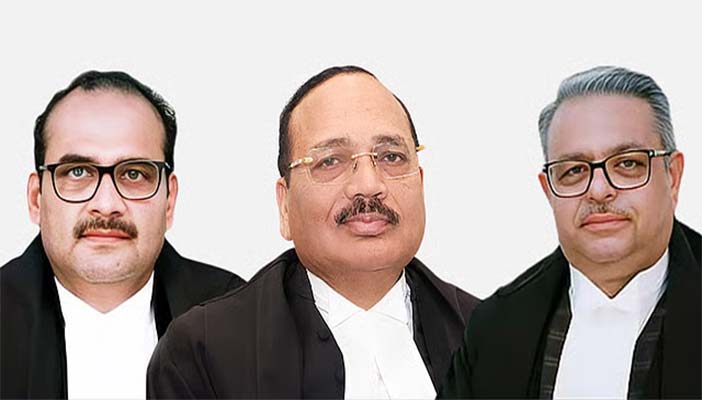
JK Maheshwari J. (L) CJI Surya Kant, Augustine George Masih (R).
Unnao Rape Case News Supreme Court: New Delhi: The Supreme Court on Monday stayed the operation of a recent Delhi High Court order that had granted bail and suspended the life sentence awarded to former Uttar Pradesh MLA Kuldeep Singh Sengar in the Unnao rape case, citing serious legal concerns that warranted closer examination.
A vacation Bench comprising Chief Justice of India (CJI) Surya Kant, Justice J.K. Maheshwari and Justice Augustine George Masih issued notice to Sengar on an appeal filed by the Central Bureau of Investigation (CBI) challenging the High Court’s December 23 verdict. The apex court directed that Sengar should not be released from jail pursuant to the High Court order.
“Issue notice. We have heard the Solicitor General for the CBI and senior counsel for the convict. We find that there are various substantial questions of law which arise. Though ordinarily this court does not stay orders of release without hearing the person concerned, in view of the peculiar facts, including that the convict is already convicted in another serious offence, we stay the operation of the Delhi High Court order dated December 23,” the Bench said.
The Supreme Court expressed apprehension over the High Court’s interpretation of the term “public servant” under Section 5 of the Protection of Children from Sexual Offences (POCSO) Act, cautioning that such a reading could potentially exclude lawmakers from the scope of aggravated offences under the law.
“Legal issues require consideration. The judges of the High Court who passed this order are among the finest judges, but we are all prone to errors. We are concerned that under such an interpretation, a constable would be considered a public servant, but a Member of the Legislative Assembly may be excluded,” the Bench observed.
READ: Delhi High Court Grants Interim Relief to Allcargo in Trademark Dispute Against “VRS ALLCARGO”
Sengar was convicted by a Delhi trial court in December 2019 for offences under the Indian Penal Code and the POCSO Act and sentenced to imprisonment for the remainder of his natural life. The conviction included aggravated penetrative sexual assault on a minor, with the trial court holding that Sengar qualified as a “public servant.”
However, the Delhi High Court, in its December 23 judgment delivered by a Division Bench of Justices Subramonium Prasad and Harish Vaidyanathan Shankar, suspended the sentence and granted bail. The High Court held, on a prima facie assessment, that the offence of aggravated penetrative sexual assault under the POCSO Act was not made out, reasoning that Sengar could not be categorised as a “public servant” under Section 5(c) of the Act or Section 376(2)(b) of the IPC. It also ruled that he did not fall within the scope of Section 5(p) of the POCSO Act, which deals with offences committed by persons in a position of trust or authority.
READ: Supreme Court takes suo motu cognisance of Aravalli Hills definition, hearing on December 29
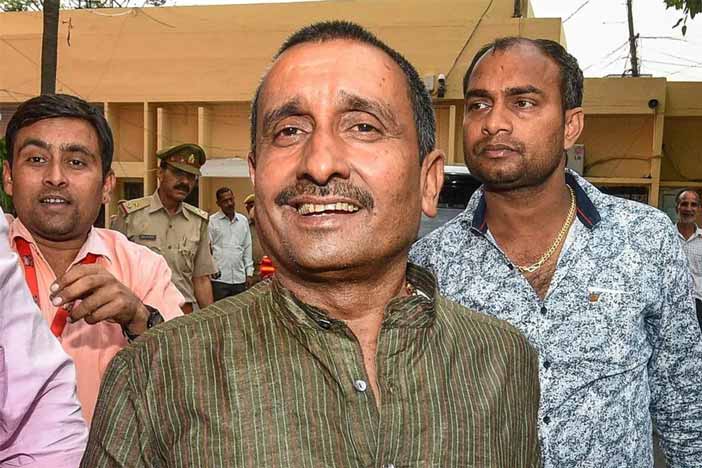
Kuldeep Singh Sengar, Former MLA.
Challenging this finding, the CBI argued before the Supreme Court that the Delhi High Court had erred in law. The agency contended that a sitting MLA occupies a constitutional position of trust and authority and performs public duties in which the State and the community have a direct interest. The CBI also raised serious concerns about the safety of the survivor and her family, pointing out that Sengar is an influential figure and that his release could jeopardise their security and undermine public confidence in the justice system.
Solicitor General Tushar Mehta, appearing for the CBI, described the case as a “horrific” instance of sexual assault of a child. He submitted that the conviction covered offences under Section 376 of the IPC and Sections 5 and 6 of the POCSO Act, noting that the trial court had recorded a clear finding that the victim was a minor, aged 15 years and 10 months at the time of the offence.
READ: Supreme Court Strips Allahabad High Court Judge Justice Prashant Kumar of Criminal Roster
One of the grounds relied upon by the High Court to suspend the sentence was that Sengar had already undergone the maximum punishment of seven years’ imprisonment under the applicable provisions. The Solicitor General disputed this, arguing that the minimum punishment for aggravated penetrative sexual assault is 20 years following amendments to the law. Justice Maheshwari, however, pointed out that the amendment enhancing punishment came into force after the commission of the offence.
During the hearing, the Bench engaged with the CBI on whether the classification of Sengar as a public servant was central to the case, given that the victim was a minor. The Solicitor General argued that penetrative sexual assault of a child is an independent offence and that aggravated circumstances only enhance punishment, without creating a new offence retrospectively.
The Solicitor General also drew the Court’s attention to the fact that Sengar has been convicted in a separate case for the murder of the victim’s father and remains in custody for that offence. He urged the Court to stay the High Court order in the interest of justice and the safety of the survivor.
Senior Advocates Siddhartha Dave and N. Hariharan, appearing for Sengar, opposed the CBI’s plea. They argued that the life sentence was imposed solely on the basis that Sengar was treated as a public servant and contended that a penal statute such as the POCSO Act cannot import definitions from another law, including the IPC.
The defence also raised concerns over social media criticism directed at the High Court judges who had granted bail. Responding to this, Solicitor General Mehta firmly defended the judges, describing them as “among the finest judges of the country with unimpeachable integrity,” and condemned any attempt to malign them.
After hearing all parties, the Supreme Court proceeded to stay the Delhi High Court order, ensuring that Kuldeep Singh Sengar will remain in custody while the legal questions raised by the CBI’s appeal are examined in detail.
READ: Andhra Pradesh High Court Stays Investigation Against Sony India MD in Consumer Fraud Case