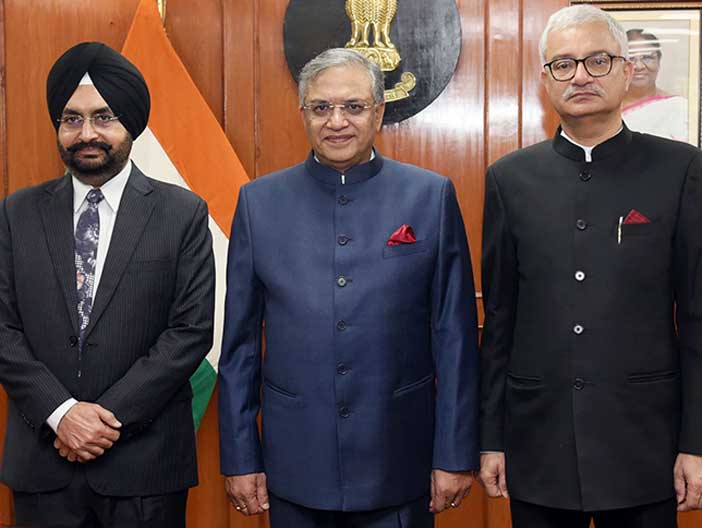
Sukhbir Singh Sandhu (L), Gyanesh Kumar (M) Vivek Joshi (R).
ECI Counsels meeting: NEW DELHI — In an era where democratic processes are increasingly scrutinized both on the ground and in the courtroom, the Election Commission of India (ECI) has pivoted its focus toward reinforcing its legal armor.
On Sunday, the ECI inaugurated the 2nd National Conference of ECI Counsels at the India International Institute of Democracy and Election Management (IIIDEM) in New Delhi. The high-stakes, one-day conclave brought together the country’s top legal minds—including advocates representing the Commission before the Supreme Court of India and various state High Courts—alongside Chief Electoral Officers (CEOs) and senior poll officials.
The central objective: to dissect a turbulent year of litigation and fortify the ECI’s legal framework against a rapidly evolving socio-political landscape.
The Foundation of Trust: Fair Rolls and Foot Soldiers
Inaugurating the conference, Chief Election Commissioner Gyanesh Kumar set a clear tone for the deliberations, tying the complexities of legal defense directly to the purity of the grassroots democratic process.
“Fair rolls lead to fair polls. That’s the moment today and India is in it,” Kumar stated.
Kumar lauded the Booth Level Officers (BLOs) and Booth Level Agents (BLAs), describing them as the “foot soldiers” of electoral roll management. He also extended congratulations to the voters of Assam, Kerala, Puducherry, Tamil Nadu, and West Bengal for their historic participation in the recently concluded Assembly elections—elections he noted were defined by an exceptionally high level of political contestation.
Acknowledging that heightened political competition inevitably spills into the judiciary, Kumar commended the panel of counsels for their tireless dedication in representing and defending the Commission’s constitutional mandate across various courtrooms.
Managing the Legal Tides
The conference, themed “A Year of Legal Challenges, Experiences, Learnings and the Way Forward,” serves as a critical diagnostic tool for the ECI. As political battles are increasingly fought via writ petitions and election appeals, seamless coordination between the Delhi headquarters and state capitals has become paramount.
Election Commissioner Dr. Sukhbir Singh Sandhu emphasized that the conclave is designed to bridge operational gaps, ensuring a unified and airtight coordination strategy between the ECI and its legal representatives nationwide.
Echoing these thoughts, Election Commissioner Dr. Vivek Joshi highlighted the dynamic nature of modern elections. He noted that the conference provides a vital forum for exchanging firsthand courtroom experiences, allowing the Commission to anticipate emerging legal challenges and formulate proactive strategies to uphold electoral integrity.
From EVMs to Media Narratives: The Agenda
The day’s agenda reflected the multi-front challenges facing modern election management. Interactive and technical sessions moved beyond abstract legal theory into practical, hands-on demonstrations:
Core Electoral Operations: Sessions deep-dived into electoral roll management, Special Intensive Revision (SIR) protocols, and strict polling and counting procedures.
Technology & EVMs: Legal counsels underwent Electronic Voting Machine (EVM) demonstrations to better equip them to handle technological skepticism in court. The role of ECINET—the ECI’s technology-driven internal network—was also analyzed to showcase how digital infrastructure aids compliance and transparency.
The Courtroom and the Court of Public Opinion: Crucially, the deliberations expanded to include the role of media narratives in judicial proceedings, examining how public perception intersects with election laws, institutional coordination, and legal reforms.
Building on the 2025 Blueprint
This conclave is not an isolated initiative. It builds directly upon the foundation laid during the inaugural National Conference held in 2025. By reviewing the progress made over the last twelve months, the ECI aims to identify systemic vulnerabilities, refine its legal arguments, and push for institutional reforms that ensure the machinery of Indian democracy remains both resilient and beyond reproach.
Don’t Miss: Striking Off Tenant’s Defence Under Order XV Rule 5 CPC Not Automatic: Supreme Court
Don’t Miss: Dignity Beyond the Device: How Vijayakumar v. State of Tamil Nadu Modernizes Justice for Digital Blackmail