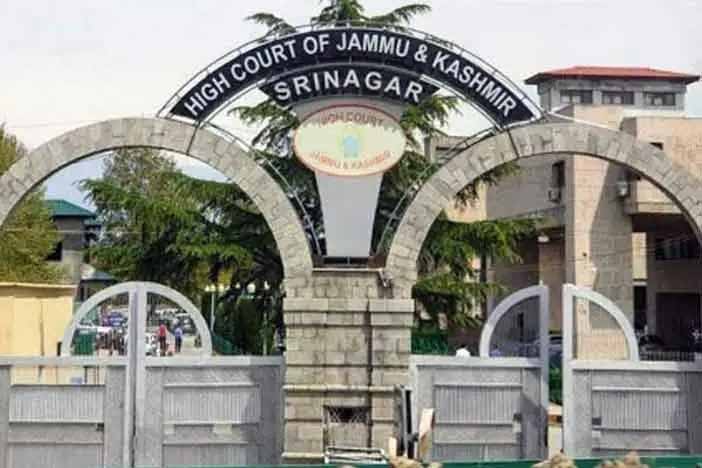
Jammu & Kashmir High Court.
The Jammu & Kashmir and Ladakh High Court recently underscored the importance of moderation in judicial conduct, particularly in interactions with members of the Bar. The observation came in the case of Sanjay Kumar & Anr v. Mohan Singh & Anr, where concerns were raised about the manner in which a Katra court conducted proceedings in a civil land dispute.
Justice Rahul Bharti emphasized that judges must demonstrate propriety and temper while addressing lawyers. “This Court would humbly remind the Presiding Officer of the court of Munsiff, Katra that propriety of judicial conduct and temper in addressing the learned Bar is a non-negotiable aspect of judicial grace,” the High Court said.
READ: Viral Video Spurs Supreme Court Action Against Alleged Misconduct of Andhra Pradesh HC Judge
Importance of Respect Towards Senior Advocates
The Bench noted that judicial grace is particularly important when senior advocates, who carry significant experience and responsibility towards both clients and the court, appear in proceedings. “Then a court is supposed to moderate its tone and tenor, which gets reflected and exposed from the very text of an order passed in that state of mind, be it agitative or equipoised,” the court observed.
The High Court was hearing a plea challenging an order of the Munsiff, Katra, in a civil suit over a piece of land in Reasi district. The plaintiffs had moved an application under Order VIII Rule 9 of the Code of Civil Procedure, seeking permission to file a replica to the defendants’ written statements.
READ: SC: Extending Chargesheet Filing Time Without Accused Hearing Violates Right to Liberty
Trial Judge’s Over-Seriousness Questioned
On April 4, 2026, the Munsiff closed the plaintiffs’ right to advance arguments on the application, prompting the challenge before the High Court. Upon reviewing the record, Justice Bharti observed that orders dated March 28 and April 4 reflected a degree of “over-seriousness” by the trial judge, which was misplaced, even if intended to expedite a matter pending since 2023.
The Court noted that a counsel had appeared before the trial court at 10:00 AM and again at 2:00 PM, by which time the trial judge had already decided to close the plaintiffs’ opportunity to argue. “There was no occasion for the Presiding Officer of the court of Munsiff, Katra to get exhausted at 1:00 pm when the court time was meant to last up to 4:30 pm, by which time the counsel for the petitioners could have been awaited considering the fact that Advocate GS Thakur is an out-stationed advocate,” the High Court remarked.
READ: Gnani.AI Raises $10 Million in Series B Round, Eyes Global Voice AI Expansion
Directions for Disposal of Pending Applications
Consequently, the High Court directed the trial court to first take up and decide the long-pending temporary injunction application based on the suit and written statements, ordering its disposal by May 30. Only after that should the plea seeking leave to file a replica be adjudicated, with a deadline of June 30.
Advocate GS Thakur appeared on behalf of the petitioners.
READ: SBI Extends ₹12,000 Crore Loan to JSW Sambalpur Steel for Bhushan Power Acquisition