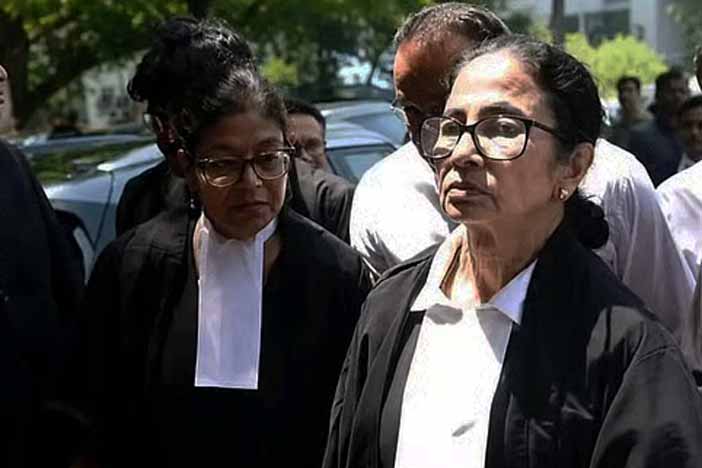
Mamata Banerjee, Former West Bengal CM, appeared as an Advocate before Calcutta High Court.
Mamata Banerjee appears as an Advocate before Calcutta High Court: KOLKATA — In a move that blurred the lines between political leadership and legal advocacy, former West Bengal Chief Minister and Trinamool Congress (TMC) supremo Mamata Banerjee appeared before the Calcutta High Court on Thursday as a practicing lawyer. Wearing her advocate’s gown, Banerjee argued in a Public Interest Litigation (PIL) seeking protection for citizens against alleged widespread violence following the 2026 State Assembly Elections, which saw the Bharatiya Janata Party (BJP) sweep to power.
The Legal Argument: “A Breakdown of Law and Order”Banerjee appeared before a Division Bench comprising Chief Justice Sujoy Paul and Justice Partha Sarathi Sen. She was arguing in the case of Sirsanya Bandopadhyay v. Union of India & Ors., a petition filed by advocate Sirsanya Banerjee (son of TMC veteran Kalyan Banerjee).
During her submissions, the former Chief Minister presented a harrowing account of the state’s current atmosphere:
Targeted Violence: Banerjee alleged that TMC workers and ordinary citizens are being systematically targeted by BJP workers. Fatalities: She informed the court that at least 10 TMC workers have been murdered since the election results were declared.
Vulnerable Groups: She emphasized that the violence has not spared women, children, or minorities.
Administrative Failure: The petition alleges that local police and administration have failed to register FIRs or provide protection to those facing arson and physical assault. “In front of the police, they are doing hooliganism and burning things,” Banerjee told the court, urging for immediate judicial intervention to protect fundamental rights guaranteed under Articles 14 and 21 of the Constitution.
READ: SC: Extending Chargesheet Filing Time Without Accused Hearing Violates Right to Liberty
Chaos in the Court Corridors
The appearance of the TMC chief in court was marked by high tension. While her legal team and supporters hailed her as a leader who “never abandons her people,” a section of lawyers at the Calcutta High Court greeted her with “thief” slogans as she exited the premises.
Senior Advocate Kalyan Banerjee, who accompanied her, criticized the heckling, stating that the court should not be a place for such political theater. “If this can happen to Mamata Banerjee, imagine what is happening currently with the ordinary workers of the TMC across Bengal,” he remarked.
Historical Context: A Tectonic Shift in BengalThis courtroom appearance comes just days after a historic political shift in West Bengal. In the 2026 elections, the BJP secured a landslide victory with 207 seats, ending the TMC’s 15-year rule.
The transition has been fraught with constitutional drama:Refusal to Resign: Following her defeat in the Bhabanipur seat, Banerjee initially refused to tender her resignation, alleging the election was a “conspiracy” involving voter manipulation.
Governor’s Intervention: The stalemate ended only when Governor R.N. Ravi dissolved the Assembly on May 7, 2026, leading to the swearing-in of Suvendu Adhikari as the new Chief Minister.
READ: Moderation in Courtroom Conduct Essential, J&K High Court Tells Trial Judge
Regulatory Scrutiny
While Banerjee’s appearance was intended to bolster her party’s legal fight, it has triggered a regulatory probe.
The Bar Council of India (BCI) has since sought clarification from the State Bar Council regarding her enrollment and practice status.Under professional rules, advocates who hold constitutional offices must suspend their practice.
The BCI is now verifying whether Banerjee officially resumed her practice after leaving the Chief Minister’s office on May 7, and whether her appearance in robes complied with the Contempt of Courts Act and professional etiquette.
The High Court has directed the state police to ensure the safe return of all displaced persons, regardless of their political affiliation, as it continues to hear the PILs.
Don’t Miss: Supreme Court Clarifies Limits of High Courts’ Powers Under Article 227, Restores Compensation Award