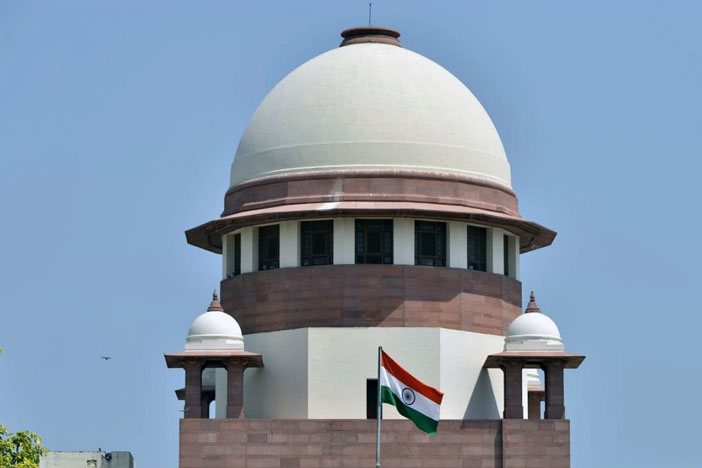
Supreme Court of India.
Whether threat to leak private videos of a woman is crime in India: NEW DELHI — In an era where a person’s entire reputation can be dismantled with a single click, the Supreme Court of India has delivered a landmark judgment that significantly strengthens the legal shield for victims of digital blackmail and non-consensual pornography.
The apex court ruled that the mere threat to upload a woman’s private video online is entirely sufficient to sustain a conviction for criminal intimidation. Crucially, the bench clarified that justice cannot be thwarted by the destruction or hiding of evidence, ruling that the physical recovery of the video or the device used to record it is not a prerequisite for conviction.
The judgment, delivered by a Bench of Justices Sanjay Karol and NK Singh in the case of Vijayakumar v. State of Tamil Nadu, fundamentally modernizes how Indian jurisprudence views cyber-enabled extortion, privacy, and female autonomy.
The Anatomy of a Threat
The roots of this legal battle trace back over a decade to 2015. The prosecutrix (the complainant) had been in a consensual relationship with the accused, Vijayakumar, for nearly two years. According to the prosecution, Vijayakumar had initially promised to marry her but later reneged on his word.
When the woman continued to insist on marriage, the dynamic turned sinister. Vijayakumar allegedly revealed that he had secretly recorded a video of her while she was bathing. He threatened that if she did not stop pursuing the relationship and the marriage proposal, he would upload the intimate footage directly to Facebook.
The legal trajectory of the case was complex. A lower trial court initially acquitted Vijayakumar of heavier charges, including rape, voyeurism, and deceitful inducement of marriage, concluding that the underlying relationship had been consensual. However, the trial court recognized the distinct trauma of the subsequent blackmail, convicting him under Part II of Section 506 of the Indian Penal Code (IPC) for criminal intimidation. This conviction was later sustained by the Madras High Court, prompting Vijayakumar to appeal to the highest court in the land.
READ: Section 138 NI Act Applies Only to Drawer of Cheque, Not Joint Account Holder: Allahabad HC
The “No Device, No Crime” Fallacy Rejected
Before the Supreme Court, the defense, led by Advocate MP Parthiban, mounted a two-pronged strategy. First, they argued that because the lower courts had acquitted the accused of the primary sexual assault and voyeurism charges, the criminal intimidation charge could not stand in isolation. Second, they relied on a classic evidentiary loophole: the police had never recovered the mobile phone or the video in question. The defense argued that without proof the video actually existed, the threat was empty and legally unenforceable.
The Supreme Court flatly rejected both assertions.
“Law does not mandate that recovery of an article of crime is sine qua non [essential condition]for conviction of an offence,” the Bench observed.
Justices Karol and Singh emphasized that criminal intimidation is an independent offense. What matters legally is not whether the criminal possesses the means to execute the threat at the exact moment of police intervention, but the psychological impact on the victim.
The court noted that the prospective leak of a nude video on social media is a “distressing and frightening proposition for a woman.” The bench ruled that if the victim genuinely believed the video existed, and if the threat successfully caused her alarm and severe mental distress, the crime of criminal intimidation was fully realized.
Redefining ‘Chastity’ for the Internet Age
Beyond the evidentiary breakthrough, the judgment is being hailed by legal scholars for its progressive reinterpretation of archaic legal terminology. Under Part II of Section 506 of the IPC, criminal intimidation carries a enhanced penalty if the threat involves “imputing unchastity to a woman.”
Traditionally, “unchastity” has been viewed through a patriarchal lens—clinging to rigid, conservative notions of traditional sexual morality. However, the Supreme Court utilized this case to decisively decouple the word from societal puritanism, tying it instead to fundamental rights.
Old Interpretation of “Chastity” —> Focused on societal morality & puritanical standards Modern Judicial Interpretation —> Focused on dignity, privacy, & individual sexual autonomy
“Chastity, thus, has to be determined not only by societal values but also based on her individual sensitivities as regards her sexuality,” the judgment stated.
The court argued that in the digital age, a woman’s dignity and privacy are inextricably linked to her ability to control her own intimate information and online reputation. Sexual autonomy dictates that a woman alone has the right to decide what remains private. Therefore, threatening to breach that privacy by publishing intimate visuals online is, by definition, an assault on her autonomy and amounts to imputing unchastity.
A Balanced Conclusion
While the Supreme Court firmly upheld the legal principle of the conviction, it took a pragmatic approach regarding sentencing. Acknowledging that the incident occurred in 2015 and that over a decade had passed, the court reduced Vijayakumar’s sentence to the period of jail time he had already undergone. The State was represented in the matter by Advocate Sabarish Subramanian.
Nevertheless, the precedent set by Vijayakumar v. State of Tamil Nadu sends a clear, chilling message to perpetrators of cyber-blackmail and “revenge porn”: destroying the evidence will no longer clear your name. In the eyes of India’s highest court, the weaponization of fear is a crime all on its own.
Don’t Miss: President Murmu Exercises Ordinance Powers to Expand India’s Top Court Bench