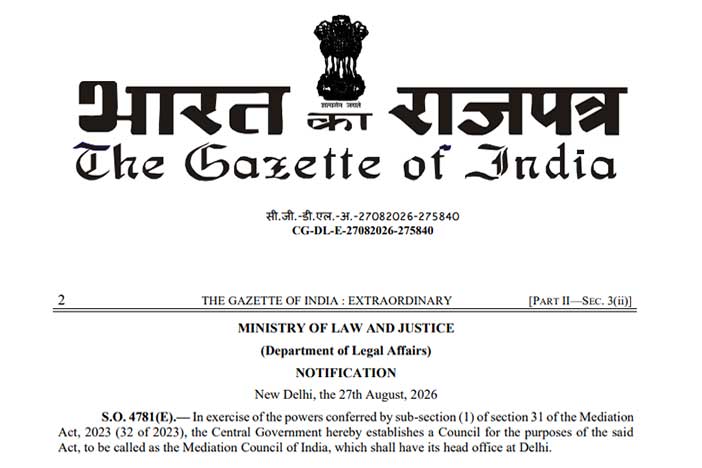
India notifies establishment of Mediation Council of India.
Mediation Council of India: The formal architecture of alternative dispute resolution in India underwent a significant institutional update with the central government’s notification establishing the Mediation Council of India (MCI). Issued through a gazette notification, the order activates provisions under the Mediation Act, 2023, creating a dedicated statutory body headquartered in New Delhi. This step transitions the framework of mediation from an informal or ad-hoc practice into a regulated, institutionalised component of the country’s judicial and legal landscape.
The establishment of the MCI addresses a core prerequisite for the operationalisation of the broader mediation framework. Under the rules outlined in the legislation, individuals and corporate entities involved in civil or commercial disputes are strongly encouraged or required to attempt resolution through mediation before approaching traditional courts or tribunals. By introducing a centralized regulatory body, the state aims to standardise training, certification, and procedural norms across the sector.
Structure and Regulatory Mandate of the MCI
The newly formed council functions as an overarching administrative and regulatory authority. Its primary responsibilities include the registration of qualified mediators, as well as the formal recognition of mediation service providers and training institutes. These institutes will bear the responsibility of conducting ongoing education, training courses, and professional assessments to maintain uniform standards of practice.
In addition to managing practitioner credentials, the council is tasked with formulating ethical guidelines and professional standards for both individual mediators and institutional service providers. By establishing an institutional framework, the regulatory body seeks to ensure that mediation processes adhere to consistent rules of confidentiality, neutrality, and procedural fairness, thereby bolstering confidence among litigants and commercial stakeholders.
Mechanics and Timelines of the Mediation Process
The underlying legislation establishes distinct parameters governing how disputes are processed, managed, and concluded. When a dispute arises, parties retain the autonomy to mutually select an independent mediator of their choice. If consensus cannot be reached regarding who should oversee the proceedings, the disputing parties can enlist a recognized mediation service provider, which will appoint a qualified professional from its panel.
To prevent protracted delays, the statute imposes strict timelines on the procedure:
Initial sessions: Disputing parties are permitted to withdraw from the mediation process after completing two sessions without penalty or prejudice.
Standard completion window: The entire mediation proceeding must be completed within a period of 180 days from the commencement date.
Extended timeline: Parties can mutually agree to extend the process for an additional period of up to 180 days if negotiations show constructive progress.
Certain categories of disputes are explicitly excluded from this framework. Matters involving criminal prosecution, or those that directly impact the rights of third parties who are not participants in the agreement, are deemed inappropriate for mediation. The central government retains the authority to modify or expand this exclusion list as operational experience dictates.
READ: Supercharging AI: Inside AMD’s Strategic Acquisition of MEXT Corporation
Legal Enforceability of Settlements
A critical element of the legislative framework is the legal status assigned to the outcome of successful proceedings. When parties reach an amicable resolution, the resulting mediated settlement agreement is drafted and formally signed.
Under the provisions of the Mediation Act, these agreements carry legal standing equivalent to court judgments or decrees. They are binding on the disputing parties and enforceable through legal channels, providing legal certainty comparable to formal litigation outcomes without requiring a full trial. This enforceability mechanism is designed to reduce the high volume of pending litigation clogging formal courts while offering a predictable, time-efficient alternative for resolving commercial and civil conflicts.
Don’t Miss: Court Rules Against Flipkart Founders: Inside the ED’s Investigation into WS Retail
Also Read: Sarvam AI Secures $300M Series B to Advance Agentic AI and Cybersecurity