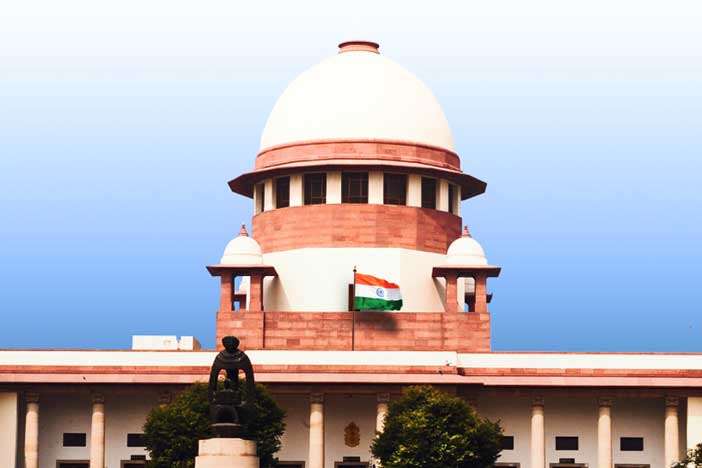
Supreme Court of India.
Supreme Court News: New Delhi: In a significant step aimed at streamlining criminal trials and preventing avoidable delays, the Supreme Court has directed that every chargesheet, challan and final report filed in criminal cases must clearly disclose whether any cross-case or other related case arising from the same incident is pending.
A Bench comprising Justice Rajesh Bindal and Justice Manmohan said that such disclosure must be made at the time these documents are filed before the trial court. The direction came after the Court noted that the absence of this information had led to serious procedural complications, with one case reaching the stage of final arguments while its cross-version had not even begun.
“This will enable the Court concerned to take appropriate steps, and get the trials in those cases clubbed, if required. The process will save the criminal justice system from creating an anomalous situation and also check delays,” the Bench observed.
READ: ‘Sar tan se juda’ slogan challenges India’s integrity, incites rebellion: Allahabad High Court
The ruling was delivered while hearing an appeal challenging an order of the Allahabad High Court. The appellants had sought the clubbing of two criminal cases that arose from the same incident in 2009. The cases were cross-versions, with rival parties lodging FIRs against each other over the same sequence of events.
The Supreme Court noted that such cross-cases typically involve common facts and witnesses and are therefore generally required to be tried together to avoid conflicting or contradictory findings.
In the present matter, the Court found that neither the prosecution nor the parties had informed the respective trial courts that a cross-case was pending in another court. As a result, one case was being tried as a sessions case and had reached the stage of final arguments, while the parallel case arising from the cross-FIR was pending before a magistrate and had not even reached the stage of recording evidence.
Describing this as an “avoidable situation,” the Court said timely disclosure of cross-cases at the stage of filing the chargesheet or final report would help trial courts take corrective steps at an early stage.
READ: Ease of Justice Is Crucial for Ease of Living: PM Modi
The appellants argued that since both cases stemmed from the same incident, they should be tried together before the sessions court. They also informed the Supreme Court that they were not seeking recall or further cross-examination of witnesses already examined in the sessions trial, but only the transfer of the cross-case for a joint trial.
The respondents, including the State of Uttar Pradesh, raised no objection to the clubbing of the trials.
Allowing the appeal, the Supreme Court set aside the High Court’s order and directed that the case pending before the magistrate be transferred to the court of the 3rd Additional District and Sessions Judge, Bahraich, where the sessions trial was already underway. The Court ordered that both cases be tried together and that judgments be delivered simultaneously.
The petitioners were represented by advocates Kushagra Pandey, Ved P. Singh, Ankita Gupta and R.C. Shukla. The respondents were represented by advocates Namit Saxena, Vishal Arun Mishra, Divyangi Gupta, Kirtivardhan Singh, Rupali Panwar, Ashok Sharma, Sandeep Mehta, Avinash Kumar Singh and Dinesh Kumar.