
BRICS Justice Ministers meeting, Gujarat, India.
BRICS Justice Ministers 2026 meeting India: GANDHINAGAR, India — In a major move to reshape the legal landscape of emerging global economies, the Justice Ministers of the BRICS nations have officially committed to a sweeping overhaul of how international commercial and civil conflicts are resolved.
Meeting under India’s 2026 BRICS Chairship in the city of Gandhinagar, Gujarat, the bloc adopted a landmark declaration aimed at elevating Alternative Dispute Resolution (ADR)—specifically mediation and arbitration—to a primary, rather than alternative, mechanism for justice.
The “Declaration of the Ministers of Justice of the BRICS Countries on Strengthening Alternative Dispute Resolution through Capacity Building in Mediation and Arbitration” was signed on May 21, 2026, following two days of intense, closed-door negotiations among senior legal officials.
The agreement marks a significant milestone for the expanded alliance, bringing together established members alongside newer entrants to create a unified framework for cross-border dispute resolution. Ministers and high-level delegations from Brazil, China, Egypt, Ethiopia, India, Iran, Indonesia, Russia, South Africa, and the United Arab Emirates all took part in the summit.
Shifting the Burden: Why ADR Matters Now
For years, the formal judicial systems across many BRICS nations have grappled with severe case backlogs, prolonged litigation cycles, and skyrocketing legal costs—factors that heavily weigh down domestic businesses and foreign investors alike. By formalizing a collective push toward institutional mediation and arbitration, the bloc is attempting to bypass traditional court bottlenecks.
According to the joint statement released by India’s Ministry of Law and Justice, the primary objective of the Declaration is twofold:
To significantly reduce the overwhelming burden on domestic judiciaries.
To foster a highly predictable, efficient, and stable legal environment conducive to international trade and investment.
As economic ties within the expanded BRICS+ framework deepen, the volume of cross-border commercial transactions is expected to surge. When contract disputes inevitably arise, relying solely on local courts can introduce jurisdictional friction and delays. A robust, recognized ADR framework offers a neutral ground that global investors typically prefer.
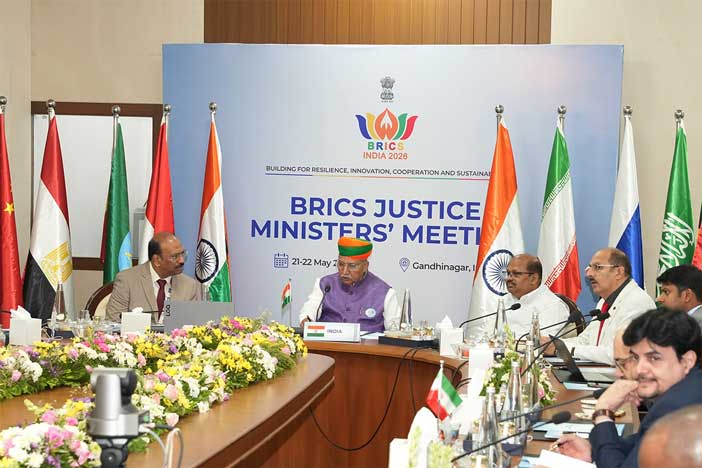
BRICS Justice Ministers meeting, Gujarat, India.
The Three Pillars of the Gandhinagar Declaration
The newly adopted framework rests on three critical pillars designed to modernize the legal infrastructure of member states:
1. Mass Capacity Building and Training
The core of the declaration focuses on upskilling the human capital required to run an efficient ADR system. The agreement outlines specialized, collaborative training programs targeting a broad spectrum of legal stakeholders, including:
Government Legal Officers handling state contracts.
Mediators and Arbitrators tasked with neutral adjudication.
Judges and Legal Professionals who must recognize and enforce these alternative rulings.
2. Institutional Reform and Enforceability
A common criticism of mediation and arbitration in developing economies has been the varying degrees of enforceability. The Ministers have pledged to pursue systemic reforms that will enhance the accessibility and efficiency of these mechanisms, ensuring that an arbitral award or mediated settlement reached in one BRICS nation carries ironclad legal weight in another.
3. Digital Innovation and Knowledge Sharing
Recognizing the rapid evolution of legal technology, the declaration emphasizes the integration of digital tools. This includes the deployment of Online Dispute Resolution (ODR) platforms, AI-driven case management systems, and a dedicated channel for member states to share best practices regarding legal innovation.
READ: Striking Off Tenant’s Defence Under Order XV Rule 5 CPC Not Automatic: Supreme Court

BRICS Justice Ministers meeting, Gujarat, India.
A Shared Geopolitical Vision
The timing of the declaration is notable. As BRICS continues to position itself as a counterweight to traditional Western-dominated global institutions, establishing its own robust legal ecosystems is a natural next step. By creating an interconnected network of arbitration hubs, the bloc is effectively building the legal infrastructure required to support a multipolar economic reality.
In a statement following the announcement, India’s Department of Legal Affairs welcomed the consensus, stating that it “looks forward to follow-up initiatives and collaborative projects that will operationalise capacity building and institutional reforms in ADR.”
While the adoption of the Gandhinagar Declaration is a diplomatic success for India’s 2026 chairship, the true test will lie in its implementation. Harmonizing the diverse legal traditions of countries ranging from Brazil’s civil law structure to the Islamic jurisprudence elements in Iran and the UAE will require sustained technical cooperation. However, with political will now formally codified, the blueprint for a revamped BRICS legal order has officially been laid.
Don’t Miss: Section 138 NI Act Applies Only to Drawer of Cheque, Not Joint Account Holder: Allahabad HC